Any devastation caused by wars or disasters creates a con e -term planning and the need to meet the immediate needs of the population at once. As the experience of recovery after the Second World War has shown, a trade-off between quality and speed always leads to delayed consequences in the future, and what was intended to be temporary turns into permanent inconvenience. At the same time, each crisis reveals deeper issues that affect the resilience of the built environment: the capacity to respond quickly, adapt and recover after a disaster, and to be prepared for future challenges.

A look at the context of residential development in Ukraine, shows that at the beginning of the full-scale invasion, we had predominantly outdated housing stock with inefficient management models and no examples of high-quality and thorough reconstruction which would improve not only the quality of structural performance, but also the quality of life. Most new buildings inherited the mistakes of Soviet development without its advantages: the environment and public spaces were ignored, the area of green infrastructure was reduced, the problem of parking worsened, and the inhuman scale was maintained, destroying neighbourly relations and preventing the development of communities.
At the level of the urban environment, the mono-functional territories of residential areas encouraged monocentric development of the city with the concentration of services and employment in the historic centre, abandoned peripheries and an ever-increasing load on the transport infrastructure.

The war, in turn, has revealed the problems with housing affordability and real estate market regulation, logistics, access to local resources, and the vulnerability of critical infrastructure and civil defence. Further consequences in the areas of economy, demography and the environmental will determine future reconstruction strategies. At the same time, the threats posed by the climate change are becoming more immediate and the issue of urban preparedness for torrential rains, o, droughts, extreme temperatures and reduced crops and available drinking water is becoming more acute.
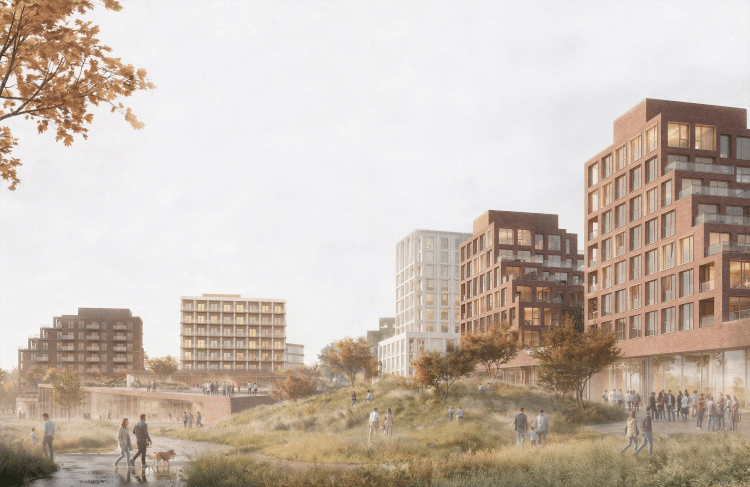
The above is only a small proportion of the challenges that arise in connection with the reconstruction of Ukrainian cities. This book offers a particular lens to look at reconstruction that takes these challenges into account and analyses them in order to propose new approaches and principles for transforming the living environment. The practical application of these principles is examplified by a pilot project of a residential neighbourhood.
The proposed research and guidelines are aimed at municipalities, international and national institutions, as well as all other stakeholders seeking to improve the living environment in Ukraine.
All statistical data in the book are quoted as of winter 2023.